Structural Drying and Dehumidification in Moorpark, CA
Framing, drywall, subfloor and concrete hold water long after the surface feels dry. The drying team places air movers and LGR dehumidifiers to the class of loss and logs readings until the materials are dry.
(888) 578-6508Book structural drying equipment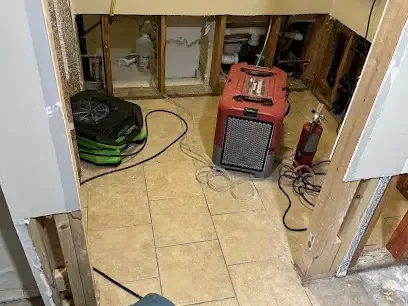
Structural drying is the part of the job nobody sees once the water is gone. Extraction removes the standing water; drying removes the water inside the materials. Drywall wicks, framing absorbs, and concrete slabs hold water for days. In local homes the usual cases are slab leaks, supply line failures inside walls, garage water heaters and winter storm runoff.
How structural drying and dehumidification is handled, step by step
Map
Moisture map and dry reference readings.
Place
Air movers and dehumidifiers to the class of loss.
Monitor
Daily psychrometric and material readings.
Verify
Equipment leaves when readings match dry.
How drying equipment is placed
Drying is planned from the class of loss, which describes how much water the materials absorbed.
- Class 1: little water, low-porosity materials
- Class 2: a whole room, carpet and wall bottoms wet
- Class 3: water from above, walls soaked high
- Class 4: dense materials like hardwood, plaster and concrete
Air movers sweep wet surfaces, LGR dehumidifiers pull the moisture out of the air, and desiccant units handle slabs and dense materials.
Walls still damp days later? The drying team sets equipment and logs readings 24/7.
(888) 578-6508Get daily moisture readings goingWhy readings decide when equipment leaves
Surfaces feel dry long before the inside of the material is. Each day the technician records temperature and humidity inside and outside the drying area, and readings on the wet materials.
- A dry reference reading from an unaffected part of the house
- Materials dried to within 2 to 4 points of that reference
- Equipment adjusted or added when readings stall
Drying starts after water extraction, never instead of it.
Containment, dry air and the claim
Containment keeps the dry air where it is needed and shortens drying time. Mold can begin to grow within 24 to 48 hours on wet materials, which is why drying starts right away. The daily logs become the record that shows the adjuster why each piece of equipment was there.
What does structural drying and dehumidification cost in Moorpark, CA?
Structural drying here typically runs $1,200 to $20,000. The class of loss, the square footage, whether desiccant units are needed for slabs and how many days of monitoring the readings require set the cost; it is often part of a larger mitigation scope.
One room, Class 1 or 2
- Air movers and LGR unit
- 3 to 4 days
- Daily readings
Several rooms, Class 3
- Wall cavities and ceilings
- Containment
- Multiple dehumidifiers
Class 4, slabs and wood
- Desiccant drying
- Floor mats
- Extended monitoring
What moves the number
Ranges are typical, not a quote. The category of water, the square footage, the material class and how fast drying started move the number most. Run the water damage cost calculator for a closer range.
First steps for structural drying and dehumidification
Stop the source
Make sure no new water is reaching the area.
Remove standing water
Extraction comes before any drying equipment.
Keep the house closed
Close windows during drying unless the technician says otherwise.
Leave equipment running
Do not switch off air movers or dehumidifiers between readings.
Structural drying and dehumidification across Moorpark and eastern Ventura County
The restoration team covers ZIP 93020 and 93021, from Old Town and High Street north of Route 118 to Peach Hill and Mountain Meadows south of the Arroyo Simi, out to Walnut Canyon, Campus Road and the country club area.
Coverage also reaches Oak Park, Simi Valley, Thousand Oaks, Camarillo, Oxnard, Port Hueneme, Ventura, Ojai.
Related water damage services
Structural Drying and Dehumidification questions in Moorpark, CA
What does structural drying mean?
It is drying the building materials themselves, not just the surfaces: framing, drywall, subfloor and concrete. Air movers, dehumidifiers and daily readings bring them back to a dry reference.
Why can't the fans come out when the room feels dry?
Surfaces dry first while the inside of drywall, wood and concrete stays wet. Readings decide, so equipment stays until materials are within 2 to 4 points of a dry reference.
What is an LGR dehumidifier?
Low grain refrigerant dehumidifiers pull more water out of the air than standard units, especially once the air is already fairly dry, which keeps evaporation going near the end of a job.
How long does structural drying take?
Most jobs take three to seven days. Class 4 losses with hardwood, plaster or concrete can take longer, and contaminated water adds removal and cleaning first.
Is it loud or costly to run the equipment?
Air movers and dehumidifiers are noisy and draw power for several days. The drying plan uses only what the class of loss needs, and readings show when units can be removed.
Still wet behind the walls? Get the structure dried properly.
Water inside framing, drywall and concrete stays long after the surface feels dry. The drying team dries it to the readings.
(888) 578-6508Schedule drying equipment now