Structural Drying and Dehumidification in Ojai, CA
Water that soaks into walls and subfloors does not leave on its own. The crew maps the moisture, runs air movers and dehumidifiers, and measures until every material reaches a dry reading.
(888) 578-6508Call about wet walls and floors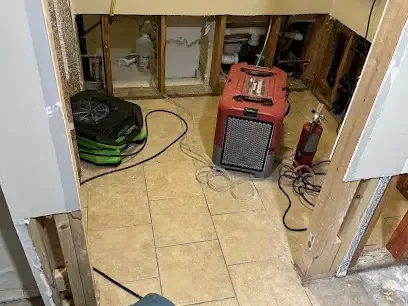
Ojai averages 44.2 rain days a year, most of them between October and April, and most homes were built between 1940 and 1980. In older houses, wall and floor cavities hold moisture that is invisible from the surface, so the crew maps the wet areas with meters before anything is closed up. Structural drying is the part of a water job that takes the longest and matters the most, because materials that look dry can still hold enough water to feed mold.
How structural drying and dehumidification is handled, step by step
Map moisture
Meters mark wet areas.
Set equipment
Airflow targets the map.
Track readings
Daily numbers show progress.
Pull equipment
Dry readings end the job.
Mapping before drying
Meters and thermal imaging draw the boundary of the wet area.
- Probes check drywall, framing and subfloor
- Thermal imaging highlights cold wet spots
- Readings are recorded room by room
- Wet cavities behind cabinets are flagged
The map decides where every piece of equipment goes.
Walls or floors still damp after the water is gone? Call and the crew maps and dries them.
(888) 578-6508Ask about the drying planThe equipment
Drying is a balance of air movement and moisture removal.
- Air movers send dry air across surfaces
- Dehumidifiers pull vapor out of the air
- Wall cavity systems push air inside walls
Equipment is repositioned as the readings change from day to day, and nothing is removed early.
Knowing when it is dry
Daily readings show when each material reaches dry reference points. Equipment stays until they do, then comes out, and the final readings are saved for the file. A wood floor needs particular care, as described in hardwood floor water damage, and sources such as burst pipe water damage usually need this step.
What does structural drying and dehumidification cost in Ojai, CA?
One room at Class 1 or 2 usually runs $1,200 to $4,000, several rooms at Class 3 $4,000 to $10,000, and Class 4 with slabs and wood $10,000 to $20,000. Material, area and wetness set the scope.
One room, Class 1 or 2
- Moisture mapping
- Air movers
- Dehumidifier
Several rooms, Class 3
- Wall cavities
- More equipment
- Daily readings
Class 4, slabs and wood
- Dense materials dried
- Long monitoring
- Specialty drying
What moves the number
Ranges are typical, not a quote. The category of water, the square footage, the material class and how fast drying started move the number most. Run the water damage cost calculator for a closer range.
First steps for structural drying and dehumidification
Map the wet area
Meters and imaging mark every wet surface.
Place the equipment
Air movers and dehumidifiers go where the map points.
Read every day
Moisture readings are logged and equipment is moved.
Release when dry
Equipment comes out after readings reach dry points.
Structural drying and dehumidification across Ojai and nearby communities
Structural drying covers homes, rentals and shops from downtown and Krotona to the foothills and the northern subdivisions, where wall and floor cavities in older houses are mapped before they are closed up again.
The same service nearby: structural drying and dehumidification in Moorpark, Ventura, Oxnard.
Related water damage services in Ojai
Structural Drying and Dehumidification questions in Ojai, CA
How long does structural drying take?
It depends on the materials and how wet they became. Equipment stays until daily readings reach dry reference points for each material, not for a set number of days.
Why are the machines so loud?
Air movers push large volumes of air across surfaces and dehumidifiers run continuously, so the noise reflects the work being done.
Can wet walls dry without opening them?
Sometimes. Small holes or removing baseboards can let air reach the cavity, and larger openings are made only when readings show trapped water.
Why does the crew come back each day?
Readings change as materials dry, so equipment is moved and adjusted. Daily checks also confirm that nothing new is wet and that the drying is on track.
Does drying prevent mold?
Proper drying removes the moisture mold needs, which is why it starts early. Materials that stay wet for more than 24 to 48 hours risk growth.
Dry the structure, not just the surface
Hidden moisture in framing and subfloors keeps causing damage. Call now and describe where the water went.
(888) 578-6508Call about wet walls